
Psychology at Durham is an incredibly diverse and broad course: from Clinical Psychology to Forensics, Cognitive and Biological Psychology to Statistics, there’s a module for everyone!
Why did I pursue Psychology?
Choosing an area of study can be difficult. Before coming to university, I studied English Language, Law and Criminology at A-Level, finding myself drawn to essay-based subjects. When it came to applying to university, I struggled to narrow down my interests; I found that my interests were quite varied, making it difficult to settle on a single discipline. Having attended various open days and subject talks, I still didn’t know what was right for me.
I decided that instead of separating my interests, I could try to find a subject that combined them – Psychology. With the likes of Legal Psychology, Clinical Psychology, and Social Psychology, I was thrilled to find a degree that encompassed different areas I enjoyed.
A typical week at Durham
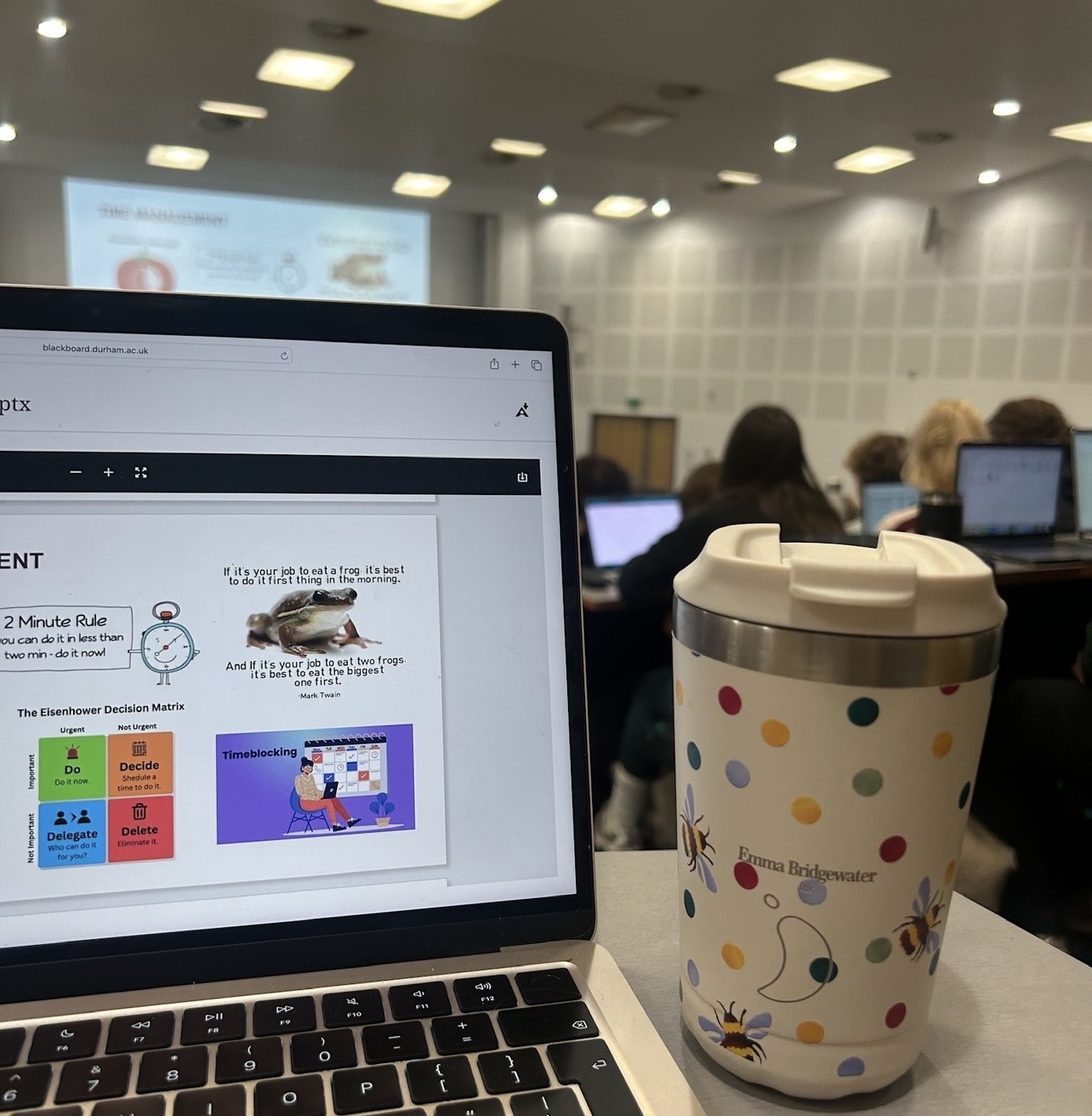
An average week studying Psychology at Durham consists of around 8 hours of lectures, across 4 days. On top of this, we have an hour-long tutorial every fortnight, as well as a couple of workshops per term. Although these contact hours may seem limited, it ensures students have time to reflect on the content, consolidate their knowledge and keep up with other modules’ teaching. There are additional sessions, such as drop-ins or revision classes, sprinkled across the semesters, which ensure you can get any support you might need outside of class!
Mixed assessment methods
Psychology at Durham is graded using mixed assessment methods, meaning each module is usually assessed on more than one piece of work. In year 2, we had 3 online essays, 1 lab report, 1 online presentation, 2 online statistics exams, 3 multiple choice tests (MCQ tests) and 2 in-person essays. If you’re somebody like me whose strengths aren’t in timed exams, your grade won’t be entirely determined by that, which can be really reassuring. It’s also a great way to develop skills across these methods, for instance, in building confidence around research for online essays or data analysis for lab reports.
What makes it special
The Psychology department at Durham has a range of opportunities for students, providing experience outside of academics. Last term, I began volunteering as a Research Assistant in a project surrounding student engagement with critical issues in psychology. Throughout this process, I have been supported by my project lead in various new skills and activities: creating surveys, analysing data, and beginning to establish focus groups. Research Assistant schemes are advertised throughout the year, making research experience accessible to all students across areas such as development, attitudes or conceptual processing.
Additionally, students have access to SONA – a platform facilitating research to be conducted and participated in. This gives both staff and students the means to recruit participants, while giving students a unique opportunity – some examples of current research
projects involve electroencephalogram (EEG) testing, which measures and records the electrical activity of the brain using small, metal discs (electrodes) attached to the scalp, or research group participation. It’s a really exciting opportunity to see the types of research being done and to contribute to meaningful work!
Conclusion
Studying Psychology has allowed me to develop academically and personally, and take part in some really exciting projects! To explore such diverse topics, facilitated by great academic support, studying at Durham is an amazing experience.
Discover more
Feeling inspired? Visit our Psychology webpages to learn more about our postgraduate and undergraduate programmes.
Create your own personalised prospectus here
Follow our students on Instagram, TikTok and YouTube