


Why Finance?
At school, I always enjoyed Maths, particularly the logical side of working through problems to find their solutions. My interest in Finance began through A Level Economics, where I was first introduced to financial markets. As I learnt more about them, I started paying closer attention to financial news and following market developments, which gradually deepened my interest.
I became interested in understanding why markets move and the impact financial decisions have. Finance seemed like a natural combination of my interests, allowing me to use the logical, problem-solving aspect I enjoyed in Maths while exploring the financial markets that had first caught my attention through Economics.
Why Durham?
When I was choosing universities, Durham stood out to me because of both the city and its collegiate system. I really liked the idea of being part of a smaller, close-knit community within a larger university. Since joining my college, I’ve met so many people I probably wouldn’t have otherwise, and it’s been one of the best parts of my experience at Durham. The city itself is also very compact, so everything is within walking distance, making it easy to get around and spend time with friends.
The Finance programme at Durham appealed to me because of its breadth. The course covers everything from Corporate Finance and Valuation to Financial Econometrics and Programming for Finance. I liked that I would be able to explore different areas of finance before deciding which ones interested me most, whilst also developing skills that would be useful for my career.

How is studying at university different to school?
One of the biggest differences is that learning becomes much more independent at university. You learn the main ideas in lectures, but you’re encouraged to develop your understanding through applied discussion in workshops, wider reading and independent study. You also have access to academic advisors, who can offer advice and support throughout the course.
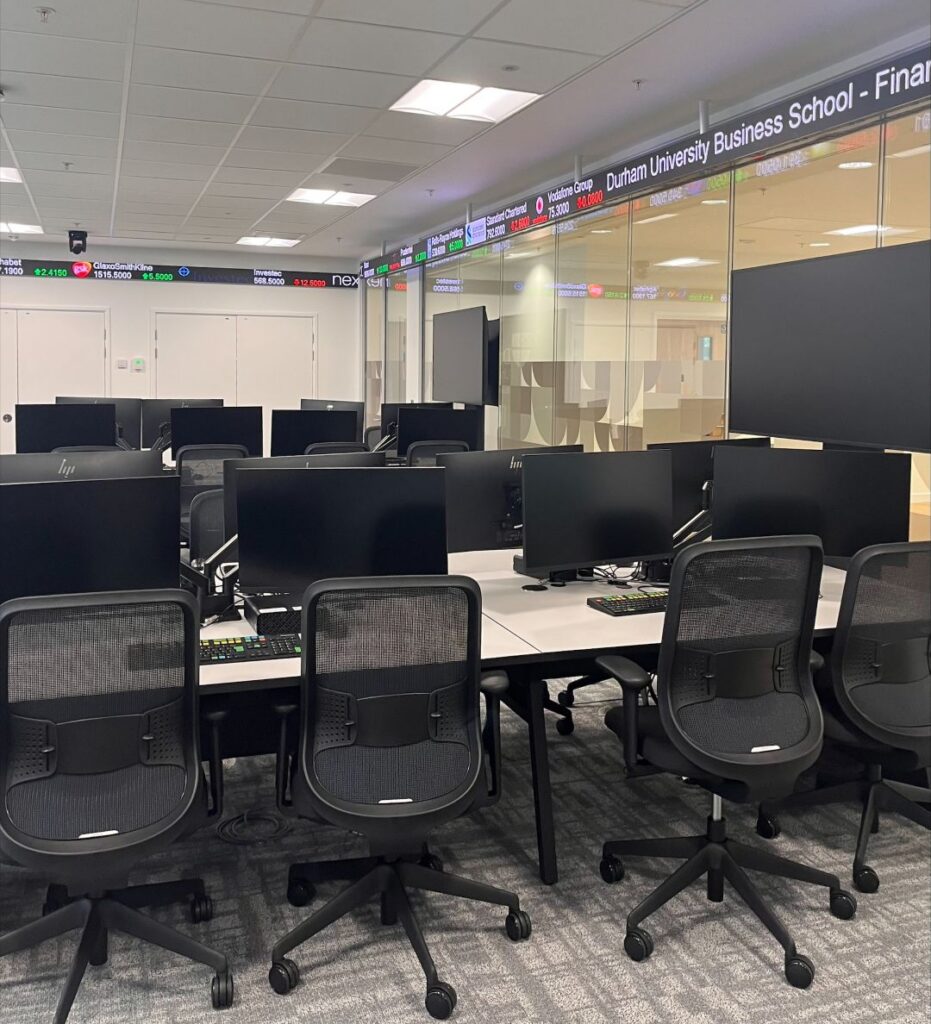
There are plenty of opportunities to apply the skills and theory you learn to real-life examples. For example, in my Corporate Valuation module, I was given an existing company and had to determine whether it was overvalued or undervalued using different valuation models and techniques that I had learnt in class. I also had the opportunity to use Bloomberg Terminals to find and analyse company and market data. I particularly enjoyed this because it allowed me to see how the theory we learn in class can actually be applied in practice.
My favourite bit
What I enjoy most about studying Finance is the variety and the opportunity to apply what I learn to practical examples. I’ve had the chance to explore the more technical side of Finance by learning statistical software such as Stata, coding in Python and using Bloomberg Terminals to extract and analyse market and company data.
I like that what we learn isn’t just theoretical, and that we get the chance to actually use it. I also like that the course covers such a wide range of topics, so there is something to appeal to everyone.
Discover more
Take a look at Durham University Business School
Download our latest prospectus and college guide here.
To see more of Durham student life, follow The Durham Student on Instagram, TikTok and YouTube.